1 min read
The Future of Live is Operational
As live experiences become business-critical, success is increasingly determined not by the technology you buy, but by the operational capability...
What Integrate 2026 revealed about the future of Live.
Live has become an increasingly important part of how organisations communicate, from executive town halls and major announcements, to public communications and global hybrid event broadcasts.
With that comes a different kind of decision.
How much capability should you own? What belongs in the cloud? What needs to remain on-premises? When should you bring in specialist expertise? And how do you invest enough to deliver the experience audiences expect without building an environment that's more complex, or expensive, than it needs to be?
In early September 2026 at Integrate Expo in Australia, those questions surfaced repeatedly.
Across two industry panels featuring Corrivium Founder & CEO Steve Jones, they explored the convergence of broadcast and AV, and the evolution of cloud and hybrid broadcast workflows, and a more mature conversation emerged. Looking forward, Live is becoming less about choosing between technologies and more about designing the right operating model for the outcome.
For organisations investing in Live, that's an important shift.
The convergence of broadcast and AV isn't new. What has changed is the standard audiences now expect.
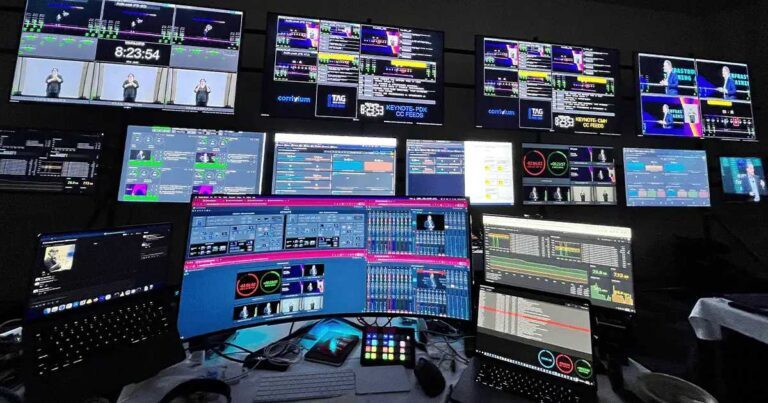
Traditional broadcast has always operated with the understanding that there are no second chances. Redundancy, contingency planning, monitoring and experienced operators exist because going off-air isn't an acceptable outcome.
Historically, expectations around enterprise streaming and AV could be more forgiving. A poor internet connection or interrupted stream might once have been accepted as part of the experience.
That tolerance is disappearing.
When a CEO addresses thousands of employees, a government communicates with the public or an organisation launches something important to customers and partners around the world, the audience doesn't differentiate between 'broadcast' and 'corporate video'. They simply expect it to work - and increasingly, to look and feel professional while doing so.
At the same time, technologies and production techniques once reserved for major broadcasters are becoming accessible across enterprise, government, education, sport and events.
That doesn't mean every Live experience needs to become a television production.
It means organisations need to think more carefully about where broadcast disciplines add business value, from resilience and redundancy to production quality and operational expertise, and, where simpler approaches are entirely appropriate.
Broadcast-grade thinking is moving beyond broadcast, because audience expectations have moved beyond broadcast.
Cloud has transformed what is possible in Live.
It has enabled organisations to access sophisticated capability without owning all the underlying infrastructure, scale resources around individual events, operate across regions and build more distributed production models.
But that doesn't automatically make 'more cloud' the right strategy.
For intermittent workloads, the ability to spin resources up when they're needed and turn them off when they're not can make enormous sense. For continuous 24/7 operations, dedicated infrastructure may offer different economic and operational advantages.
For many organisations, the answer is increasingly somewhere between the two.
A baseline capability might operate continuously, while additional cloud resources are brought online for peak events. Some workloads may remain on-premises because of bandwidth, security, latency or operational requirements. Others may naturally belong in the cloud because they need global reach, elasticity or rapid deployment.
Rather than treating hybrid as a transitional state on the journey to an entirely cloud-based future, it may be more useful to see it as an operating model in its own right.
The destination isn't necessarily cloud. The destination is the right environment for the workload.
“You need people who understand the full workflow - where the dependencies are, what can go wrong, and how each decision affects the experience you’re delivering to the audience.”
- Steve Jones, Founder & CEO
Cost inevitably becomes part of that decision, but the equation is more nuanced than whether cloud or infrastructure is 'cheaper'.
The traditional CapEx versus OpEx discussion is still relevant. Owning infrastructure requires upfront investment, while cloud can shift more technology expenditure towards an operating-cost model.
But neither tells the whole story.
How often will the capability be used? What needs to run continuously? Where are the peaks? How quickly does an organisation need to scale? What infrastructure needs to be owned and maintained? And what expertise is required to operate it?
A business running occasional Live projects may benefit from paying for infrastructure only when it needs it. As operations become more continuous, the economics can change, making an owned or committed baseline more attractive while retaining cloud for additional capacity, geographic reach or resilience.
For enterprise buyers, that opens up a more useful question than CapEx versus OpEx alone: What capability do we need every day, and what capability do we only need when it matters?
An organisation may have enough internal capability for regular town halls and everyday communications, for example, but only require broadcast-level production resources and specialist expertise for several external business-critical events each year
Building permanent infrastructure and teams around that peak requirement may make little sense. Neither does designing the peak event around the limitations of the everyday environment.
A smarter operating model allows capability, and expenditure, to expand and contract with the requirement.
The Live technology landscape is extraordinarily capable.
Cloud production, IP contribution, software-defined infrastructure, orchestration and increasingly interoperable platforms are creating options that would have been difficult to imagine a decade ago.
But capability creates its own temptation: because something can be added to a workflow doesn't mean it should be.
Complexity introduces cost. It introduces dependencies. It creates more things to monitor, manage and understand.
For decision-makers, this is where starting with technology can lead the conversation in the wrong direction. Start instead with the audience. The content. The business objective. The level of risk. The experience you need to create. Then determine the workflow and technology required to deliver it.
The sophisticated decision isn't always to deploy the most sophisticated technology. It's knowing what you need - and what you don't.
That brings another consideration into the operating model: people.
Organisations no longer necessarily need to own every capability, either in infrastructure or expertise - all of the time. Remote and distributed production can centralise operations, automation can remove repetitive tasks, and cloud infrastructure can provide access to capability on demand.
But someone still needs to understand the complete workflow.
They need to know where the dependencies are, anticipate what can go wrong, understand how one decision affects another and respond when the environment changes. And critically, they need to connect what's happening technically with the experience being delivered to the audience.
That expertise doesn't necessarily have to sit permanently inside the organisation.
The opportunity is to determine what capability should be owned internally and where access to specialist expertise, infrastructure or managed services can provide greater flexibility.
For a business whose most important Live event of the year may be just another Thursday for an experienced production team, that distinction matters.
Perhaps the most useful takeaway from Integrate wasn't a verdict for cloud, on-premises, broadcast, AV or any particular technology. It was evidence that the conversation has moved on.
As Live becomes more strategically important, organisations have more technology choices than ever. But more choice doesn't necessarily make the decision easier.
The organisations that get this right won't necessarily be those with the most infrastructure, the largest production teams or the most sophisticated technology stack. They'll be the ones that understand what they need to own, what they need to access, where specialist expertise matters and how those elements work together as one Live operating model.
That's also why the lines between broadcast, AV, cloud and IT matter less than they once did. The real opportunity lies in bringing the best of those disciplines together around the audience and business outcome.
Before the next technology investment, platform decision or major Live event, perhaps the starting question shouldn't be: Should this be in the cloud?
It should be: What are we trying to achieve and what's the smartest way to deliver it?
1 min read
As live experiences become business-critical, success is increasingly determined not by the technology you buy, but by the operational capability...
1 min read
As Live experiences become increasingly central to business communication, the organisations that thrive won't simply adopt new technologies, They'll...
1 min read
In today’s digital-first world, live streaming is no longer a “nice to have”- it’s a critical component of how organisations communicate, engage, and...